
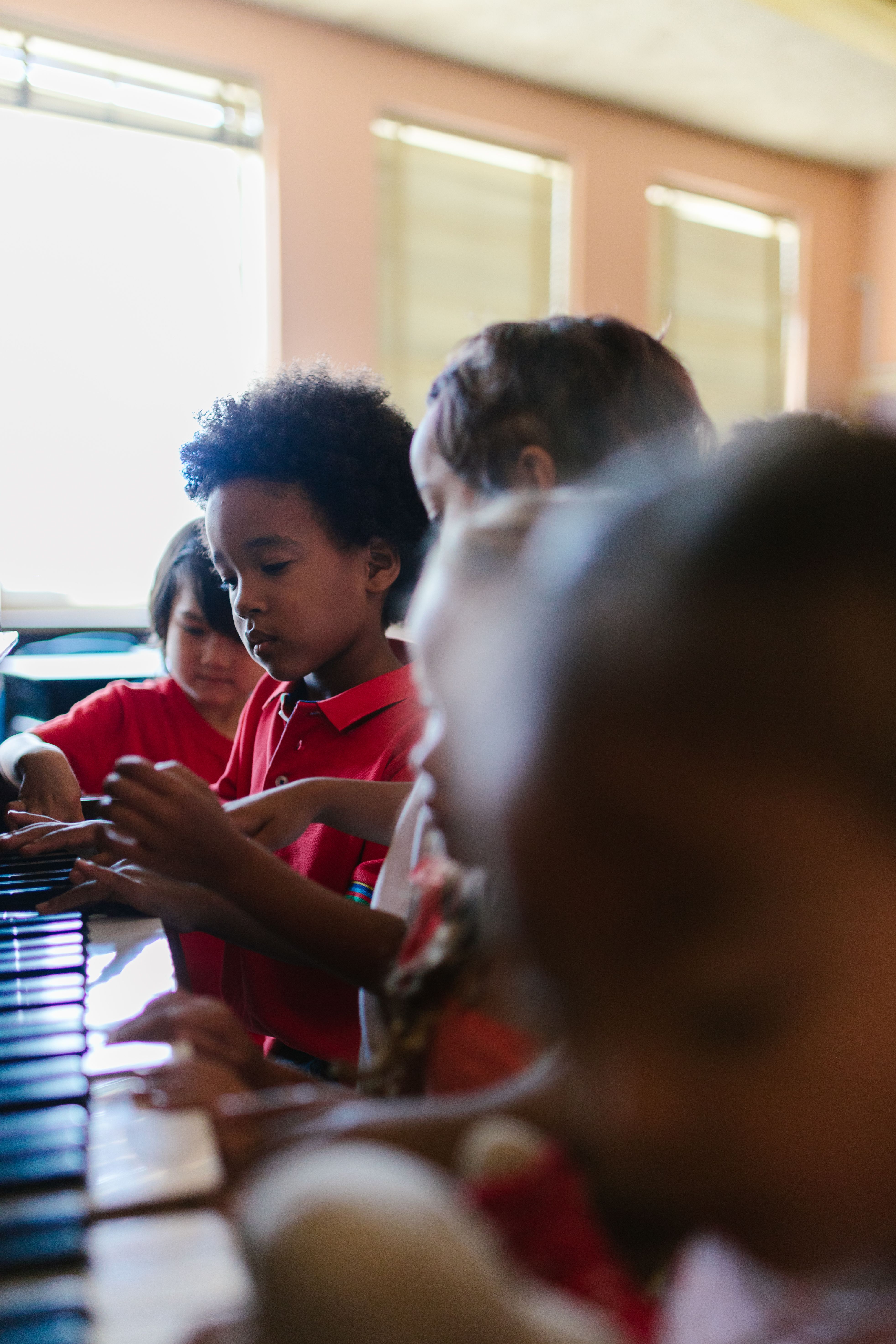
Ways to Run Group Piano Lessons
Your private lesson slots are full, there's a waitlist, and you can't really add more hours in the day. But you'd like to earn more income, or have more impact. So group lessons start to look like the answer: more kids, same hours, more money coming in. That's the pitch anyway.
Then you actually run your first group class and it doesn't go how you pictured it. One kid is racing ahead. Another one needs everything explained three times while the rest sit with their chins in their hands (or worse, are running around the room). A third one missed the last two weeks and has no idea what page everyone else is on. You end up basically giving four mini private lessons at once, in the same room, and none of them get enough of you.
Honestly, that's the most common way group lessons fall apart. Groups can work, but when people just try to run their normal private method book with more kids sitting in front of them, they don't work. If it's built for one student at a time, teaching it to four at a time is always going to be a compromise.
So if you're thinking about group lessons for the first time, here's what I'd say is worth keeping in mind.
Build the lesson around the group
The teachers I know who've kept group lessons going for years (not just tried it for a term and quit) treat it as its own thing. It's not one kid working through a book while three others sit there waiting their turn. It's built around stuff that only really works because there's a group there: singing together, rhythm work, theory games, improvising in pairs, playing something as an ensemble instead of four separate solos. Playing at the keyboard is one part of the lesson, not the whole lesson.
So when you're planning, you're not just thinking about which page comes next. You're thinking about how you move between activities, how you keep the energy up, how you can differentiate your teaching so that it suits all the levels in your group, and how each student will get the individual feedback they need.
Choose between adapting a private method and using a group curriculum
One thing you'll need to decide early is whether you stick with the method you already use privately, or switch to something built for groups. Plenty of teachers just keep using Faber, or WunderKeys, or Piano Safari, and teach the same pages to everyone, adding in their own games and ensemble bits around it. That works, but you're doing a lot of that design work yourself. Other teachers go with something built for the format from the start: Harmony Road, Music for Young Children, Piano Express, Forte, Musikgarten, Music Moves for Piano, Let's Play Music, Piano Pyramid. These usually come with the ensemble parts already written, a way to bring parents into the younger classes, and material that's actually meant to be taught to a few kids at slightly different points at once. It's not that one option is right, it's just worth knowing you're choosing between building it yourself or buying something that's already built for this.
Decide how the room will run
You'll also need to decide how the room runs. Some teachers set it up as a lab, everyone on their own keyboard, often with headphones, working through their own material at their own pace while you move around helping each one. Others run it more like a classroom, everyone singing and playing the same thing together, and the whole point is the ensemble sound, not each kid's individual pace. Both work, but they need different things from you. Lab style needs more gear (you basically need one instrument per kid), but it copes with a wider mix of levels. Classroom style needs less equipment but only really works if everyone in the group is close together in ability.
Which brings me to grouping.
Group by level, not just age
What matters is level, not age. Two kids in different years at school can be in the same group fine if they're at a similar point in their playing (although widely different age ranges will be less optimal, due to attention spans and interests). Two kids the same age but at really different levels usually can't. If you do end up mixing levels, maybe because a family needs a certain time slot, or you just don't have enough students yet to split things properly, it only really works if your material is built for that from the start, with different kids doing different things in the same session. So choosing a purpose built curriculum with materials that cater to different levels is essential here. Don't just hope it works out because everyone's friendly.
Keep some individual feedback in the lesson
Whatever format you decide on, make sure there's still some individual time built in, even if it's short. Some teachers do stations: a bit of time with you, a bit of independent practice, a bit of theory or an app. Others split the hour, working with one kid alone while the rest do something guided together or in pairs. How you manage this is less important than making sure that nobody goes a whole lesson without you actually looking at what they're doing. Kids notice when that happens. And so do their parents.
You don't have to convert the whole studio
If you're not sure this is even for you, you don't have to convert your whole studio at once. There are two lower risk ways in. One is to keep private lessons as your normal structure and swap in a group session every few weeks, or at set points in the term, instead of that week's private lesson. You get to try it, add a bit of community to the studio, without buying a room full of new keyboards before you know if you'll stick with it. The other way is almost the opposite, run group lessons only for your youngest beginners, often with a parent in the room, and then move them into private lessons once they're reading independently or want more one on one repertoire time. That way group isn't running alongside private forever, it's just how people start.
Group lessons aren't automatically easier or more profitable
Group lessons have their benefits. But please be aware that group lessons are not automatically less work or more profit. Planning for a group takes longer than planning for one student. Running it properly usually means more instruments, more space, more supervision, and that eats into the extra income as well. And it takes more energy to teach a group than teaching an individual student. There are practical things that catch people out too; you need to have enough students in a group before it's worth running the session at all, there's usually no makeup for a missed group class because rescheduling one kid means rescheduling everyone, and if you're teaching from home you need to check your insurance covers it. Some teachers try groups and love it and never go back to private. Others try it, do it well, and go back to private lessons anyway because they enjoy it more.
Either way, the groups that last are the ones built around what a group can actually do that one student on their own can't. If it's just a private lesson with more chairs in the room, it won't hold up for long.